The Promise of Virtual Reality
According to Woodford (2017) Virtual Reality (VR) can be defined as a “believable, interactive 3D computer-created world that you can explore so you feel you really are there, both mentally and physically,” often with help of special sensory equipment like headsets or gloves.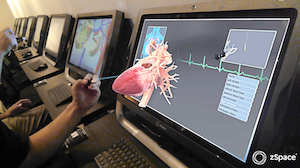 |
| Source: zSpace |
Beyond the classroom, VR allows scientists to visualize experiments or doctors to collaborate on treatments and even complete robotic surgeries from a distance (Woodford, 2017). In everyday life, VR may usurp or merge with social media by allowing users to share social occasions--or even historical events--with others.
While VR can bring new experiences to students and users across the world, it is not accessible to everyone. Most of these technologies will not be available to those without fast, reliable Internet or in decentralized locations. They are also likely to be more accessible to individuals or school districts with the means to purchase equipment.
In terms of education, embracing VR could result in students having less practice learning through relatively inexpensive, low-tech means—such as reading, lecture, discussion—perhaps lowering their abilities or willingness to learn from such methods. Just as educators lament students using technological shortcuts to solve math problems or check grammar, some may object to an increasing reliance on technology and the growing expectation on the part of students for edutainment. Alongside moral objections, those educators who embrace VR will require training, support, and materials for its implementation.
 |
| Source: The Guardian |
Finally, VR has long caused concern due to its potential for escapism, causing people to neglect the real world and their real lives. As Amabadkar (2014) notes, "an inescapable aspect of social life is the formation and maintenance of interpersonal relationships" and "interaction ought not be substituted for community." As social media has shown, virtual relationships and experiences may be appealing (and even addictive), but they may also be less psychologically fulfilling.
Types of Virtual Reality
Non-immersive VR systems are often viewed simply through a computer screen, but often involve 3-D goggles to enhance the user’s experience, such as with zSpace, a company that creates educational materials that students view on a screen and interact with through special goggles. Similarly, ThingLink360 allows users to explore an annotated 360-degree view of an environment, from a museum to the ocean floor.Immersive VR systems, on the other hand, completely immerse a person’s perspective into a virtual world. This is often achieved through a head set that covers the individuals field of vision (Amabadkar, 2014). Immersive VR may also allow a user to interact with the virtual environment around them as well, such as with SnowWorld, where patients can throw snowballs at objects in their virtual world to distract them from painful medical procedures (Marchant, 2017). The most involved examples include CAVE systems where an entire room is set up with projections and speakers to fully immerse the user's senses. However, with the help of a VR headset, such as Google Cardboard, and a smartphone, 360-degree videos (like the one shown below) can also become immersive experiences.
Semi-immersive systems rely on large screens or multiple screens surrounding the user to provide a partial sense of immersion. Flight simulators often use such technology, surrounding a seated user with a large, concave screen to mimic the experience of flying.
Cognitive and Psychological Implications in the Classroom
VR presents great potential for learning, but it carries with it emerging ethical considerations. Researchers are only beginning to examine its psychological and cognitive repercussions in educational settings. Howard Rose of Firsthand Technology describes VR as "nothing less than a superpower...a 'high-bandwidth channel' into our brains that can transform how we see ourselves and the world" (cited in Marchant, 2017). Although Rose uses VR in medical settings for pain relief, his points translate into the classroom: VR tricks our senses into thinking we are actually experiencing the virtual world, so our bodies react to it—easing pain symptoms by 60-75% (Marchant). Knowing this, how can educators embrace this "high-bandwith channel" to our brains while still managing its psychological power? |
| Source: RoadtoVR |
While the possibility of fully immersing students in virtual educational worlds is appealing, Castaneda, Cechony, and Swanson (2016) examine classroom use of VR with an eye toward ethics, pedagogy, and community-building. Notably, the authors found that students experienced intense emotional reactions to VR content due to its immersive nature, even if they knew the content was not real. Some students also expressed a lack of clarity in terms of VR representing reality--for instance, describing a historical VR recreation as actually experiencing history as it unfolded rather than noting that they had experienced a simulation created by a designer. Because VR blurs emotional and epistemological lines in new ways, educators must be aware of these complications, educate students about the nature of the content to be used, and scaffold experiences so that students do not dive into the deep end of VR immediately. Castenda, et al. also note that students should be given the option to experience material through a computer screen rather than a headset due to the potential for triggering content. When managed effectively in the classroom, with opportunities for dialogue and debriefing, the authors note that VR excites students about content and builds a sense of classroom community through shared experience.
References
Amabadkar, R. (2014, Mar. 10). Virtual Reality Systems and Applications. Slideshare. Retrieved from https://www.slideshare.net/rahulambadkar/virtual-reality-systems-and-applicationsBurch, (2016, June 2). The Top 10 Companies Working on Education in Virtual Reality and Augmented Reality. Touchstone Research. Retrieved from https://touchstoneresearch.com/the-top-
10-companies-working-on-education-in-virtual-reality-and-augmented-reality/
Castaneda, M., Cechony, A., & Swanson, T. (2016). Implications of Virtual Reality in Applied Educational Settings. Foundry 10. Retrieved from http://foundry10.org/wp content/uploads/2016/07/Implications-of-Virtual-Reality-in-Applied-Educational-Settings.pdf
Marchant, J. (2017, Apr. 24). How VR could break America’s opioid addiction. Mosaic. Retrieved from https://mosaicscience.com/story/vr-could-break-americas-opioid-addiction/
Woodford, C. (2017, Mar 3). Virtual Reality. Explain That Stuff. Retrieved from
http://www.explainthatstuff.com/virtualreality.html
Zap, N. & Code, J. (2016). Virtual and Augmented Reality as Cognitive Tools for Learning . In
Proceedings of EdMedia: World Conference on Educational Media and Technology 2016 (pp. 1340-1347). Association for the Advancement of Computing in Education (AACE).
Great use of images along with videos of relevant information on your Thinklink Photosphere. The music was fitting as well. In addition, the tags are placed in such a fashion as to make it is easy to navigate. I learn aspects of about the park I never knew. Spectacular work!
ReplyDelete“VR has long caused concern due to its potential for escapism, causing people to neglect the real world and their real lives.” This made me think of the upcoming film “Ready Player One”. It describes in detail one of the bigger concerns you have outlined. Your insight into the potential downfall of low-tech forms of learning methods if students are used to using high-tech VR is very interesting and something I had not considered. You have also outlined some great psychological concerns with using VR, I wonder if there is similar research illustrating physical effects.
ReplyDeleteThank you very much for sharing such a well thought out and in-depth analysis.