
Educational Applications
One way that these elements have been translated into
educational settings is through the use of badges to reward achievement and
competencies. The complexity of badging systems can range from giving simple
rewards to elementary-age students for reading a book to using digital badges
to track and incentivize continuing education for teachers (Johnson, Adams,
Estrada, & Freeman, 2014). Other forms of gaming, such as quizzing games
like Kahoot and Socrative Student, allow students to
review material and practices skills in a competitive setting. As an added
bonus, these games allow older students to use their beloved smartphones in the
classroom for an academic purpose!
Freedoms of Gaming
As the trend of gamification has grown, educators and researchers have begun noting and documenting its advantages. The Gamification and the Future of Education report notes the four freedoms gaming offers to learners: “the freedom to fail, freedom to experiment, freedom of effort, and freedom to self-express” (Oxford Analytica, 2016, p. 4).
Any teacher who has taught highly motivated students or those in competitive university programs knows the stress and fear of failure these students often face in the traditional grade-based learning environment. Fear of making mistakes and “failing” can stifle students’ sense of exploration and experimentation and, thus, their intellectual inquiry. When gaming allows students to explore and make mistakes in low-consequence environments, they are freer to learn by doing. The “freedom to fail” feeds the “freedom to experiment” because students no longer need to know for certain that an outcome will be successful in order to try a new tactic or strategy. If they fail in this environment, so what? It’s just a game. This can translate into more active, self-directed learning where students are liberated to explore problems, test hypothesis, and think critically rather than just memorize the right answer that will keep them from failing (Oxford Analytica, 2016, p. 30).
Any teacher who has taught highly motivated students or those in competitive university programs knows the stress and fear of failure these students often face in the traditional grade-based learning environment. Fear of making mistakes and “failing” can stifle students’ sense of exploration and experimentation and, thus, their intellectual inquiry. When gaming allows students to explore and make mistakes in low-consequence environments, they are freer to learn by doing. The “freedom to fail” feeds the “freedom to experiment” because students no longer need to know for certain that an outcome will be successful in order to try a new tactic or strategy. If they fail in this environment, so what? It’s just a game. This can translate into more active, self-directed learning where students are liberated to explore problems, test hypothesis, and think critically rather than just memorize the right answer that will keep them from failing (Oxford Analytica, 2016, p. 30).
The freedom to assume different identities can also push
students toward new perspectives and experiences. Much like reading fiction,
watching a movie, or playing around with virtual reality, when learners are
drawn into the flow of a game, they begin to empathize with new characters who
may come from backgrounds, times, and experiences that differ from their own.
While some students may be shy when it comes to participating in similar
role-playing activities in the classroom, the engrossing nature of games can
draw more introverted students into a virtual world that offers them similar
benefits.
 While the competitive nature of games can foster motivation
and social connection, it is also one reason some educators may feel reluctant
to embrace gaming in their classrooms. Just as in sports or gym class, no
student wants to stand out as they struggle to grasp a new skill or concept. The
“freedom to fail” can evaporate rapidly if self-conscious students feel
socially judged by their game performance. Fortunately, some games have
mitigated these issues by presenting team challenges that lower the individual
stakes or allowing for anonymous participation.
While the competitive nature of games can foster motivation
and social connection, it is also one reason some educators may feel reluctant
to embrace gaming in their classrooms. Just as in sports or gym class, no
student wants to stand out as they struggle to grasp a new skill or concept. The
“freedom to fail” can evaporate rapidly if self-conscious students feel
socially judged by their game performance. Fortunately, some games have
mitigated these issues by presenting team challenges that lower the individual
stakes or allowing for anonymous participation.Perhaps one of the greatest concerns with the transfer of gaming into education has to do with its very appeal: as students become extrinsically motivated to succeed in the game, this pursuit may displace the intrinsic enjoyment of learning. In other words, in an effort “to increase the time students devote to study in the short-term, gamification may reduce the long-term drive for education” (Oxford Analytica, 2016, p. 35). Just as students may be extrinsically motivated by grades, they may similarly become motivated by badges, status, or progression in the game environment. Knowing of this danger, it is important for educators and the creators of games to consider best practices that still promote the intrinsic joys of competence and social connection through gaming.
Best Practices & Critical Elements of Gamification
To make the most of gamification, educators and designers
must consider a number of best practices; a few of these include building intermittent
reward patterns into their games and thinking carefully about when and how to best use collaborative activities. While a teacher might assume
that rewarding students consistently would lead to greater learning, studies show that varying reward patterns results in greater
effort over a period of time and more continuous focus. Additionally, collaboration
and varying skill levels are serious considerations in gamification. However, when
instructors take advantage of mixed skill levels to allow students with
experience to instruct students who are just learning the content or gaming method. This
allows for exponentially more teaching across the classroom and allows the
students doing the teaching to gain new skills in explaining the concept to a
new learner (Oxford Analytica, 2016).
Some of the key elements gamification brings to the world of education are “a clearly defined set of rules, a rapid feedback system, and a
well-established goal” (Oxford Analytica, 2016, p. 3). Games come with a clear
list of what is allowed and what is not, which gives students clear parameters
in which to operate. To offer a simple example, if a teacher were to use a ‘quiz
bowl’ to review content for an upcoming exam, she would need to take into
consideration if students could use notes or books, if they can consult with
one another, how many points correct answers are worth, if wrong answers result
in negative points, and so on. While so many rules might seem restrictive, they
also give learners a clear sense of what is expected, which allows them to more narrowly focus on the lesson content. In this same type of review game, students’ efforts
are followed quickly by feedback in terms of learning if their answers are
right or wrong. Depending on the context, this may result in a badge, social
recognition, or simply the satisfaction of being congratulated on a correct
response. According to behavioral psychology, this rapid feedback loop helps to
encourage the desired behavior. Lee and Hammer (2011) also note that the
pairing of low-stakes nature of gaming with rapid feedback cycles minimizes the
unpleasant feelings typically associated with failure.
In addition to clear rules and unequivocal feedback, games
offer clear goals. For instance, in a simple quiz bowl, one team might compete
for more points than another, or students might individually collect points
toward a badge or reward. Other games might offer more sustained motivation by
allowing learners to “level up” after a series of successes. These clear-cut
rules and expectations allow learners to easily visualize and quantify their progress while looking ahead toward future achievements.
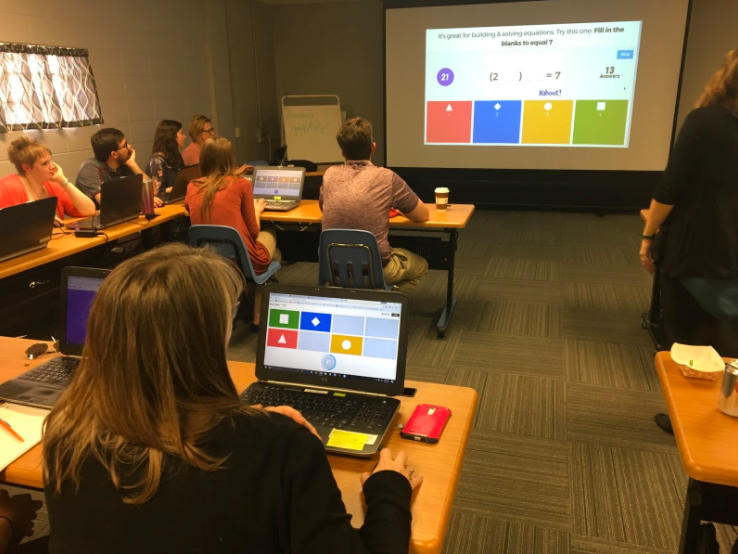 |
| Students playing Kahoot (Source: Kahoot) |
As the teacher guides students through the questions, there
is also time to give feedback on answers and for students to ask questions.
While Kahoot offers the fun of racking up points in a friendly competition, it
also allows students and the teacher to assess how well students are grasping a
lesson in a very low-stakes and engaging manner. Additionally, Kahoot shows a leader
board throughout the game that recognizes the top performers but does not show
students at the bottom of the ranking, thereby allowing for positive recognition
but minimizing the embarrassment that might come from a poor showing.
While gamification can be relatively low-tech (and has been
for years), the games being developed for this generation focus on the
potential for technology to help in teaching. As with most educational
technologies, this has the potential to leave lower-income students or
districts behind. For instance, when teachers decide to surprise their classes
with a Kahoot, they may be surprised in turn to learn that some of their
students cannot afford the smartphones or tablets necessary to participate. Similarly,
schools or classrooms lacking reliable Internet access may not have the option
to play many of the games being developed.
Additionally, while Kahoot and many other gaming platforms are quite intuitive, teachers may feel nervous or intimidated by the idea of building
their own games and trying them for the first time in the classroom. Because of
these difficulties, continuing or in-service training can be helpful in introducing
teachers to these accessible technologies, teaching them how to use them, and
allowing them to practice before a “prime time” roll out.
Conclusions for the Classroom
Overall, gamification can draw students into self-directed
learning experiences, promote complex problem-solving, and increase resiliency.
Its potential for educational engagement and motivation justify the fanfare. The structure of games, like incremental progression, facilitate motivating social and emotional elements, in particular the gamers’ immersion into a state of flow (Oxford, 2016). As Lee and
Hammer (2011) argue, it harnesses the emotional components of curiosity and joy
while the low-stakes environment of the game encourages player persistence. The
authors also note, however, that while gamification and education may appear to
be a match made in heaven—like peanut butter and chocolate—if students feel
gamification is foisted upon them in every lesson or co-opted by education,
they may come to view it more as “chocolate-covered broccoli” (p. 4).
For these reasons, Boulet (2016) argues that it is the
content of the gamification that is most important rather than the vehicle of
the game. As alluded to before, the extrinsic appeal of gaming mechanics, such
as points, badges, and recognition, may replace any intrinsic
motivation on the part of the learner. Additionally, as extrinsic rewards
decrease over time, some researchers and educators fear that gaming is trading
off a true appreciation for learning in exchange for short-term motivation. Instructional
designers and educators must remember the importance of promoting competence,
autonomy, and relatedness through gaming experiences as well so that students
do not come to rely solely on extrinsic motivation. By utilizing games that promote student
competence and autonomy in other classroom tasks, students may see more transfer
between gaming skills and real-life skills—for instance, teachers can point out
the link between a student’s performance in a spelling game and her success on
a writing assignment. Used thoughtfully alongside related content, gaming can (BAD PUN ALERT) be a real win for education.
References
Boulet, G. (2016, July 23). Gamification and Motivation: It’s
the Content That Matters, Not the Container. eLearning Industry. Retrieved from
https://elearningindustry.com/gamification-and-motivation-content-matters
Johnson, L., Adams Becker, S., Estrada, V., and Freeman, A. (2014). NMC Horizon Report: 2014 K-12 Edition. Austin,
Texas: The New Media Consortium.
Lee, J. J. & Hammer, J. (2011). Gamification in
Education: What, How, Why Bother? Academic Exchange Quarterly, 15(2).
Oxford Analytica. (2016). Gamification and the Future of Education. World Government Summit. Retrieved
from https://www.worldgovernmentsummit.org/annual-gathering/reports
Kate, I really think you did a great job thoroughly and clearly explaining Gamification and all of its aspects. I shared the list of the different platforms with my mom (as she is a teacher too). Kahoot is one I believed her and her class would benefit from. While I didn't go into great detail about the ins and outs of it, you did, so I shared this posting with her! Do you use gasification in your classroom? Do you have a favorite/preferred platform that you use? If you don't use it, will you try one of them out? I work with Pre-K aged students, and think that this would be something I could definitely use after a summer of exploring it myself!
ReplyDelete